
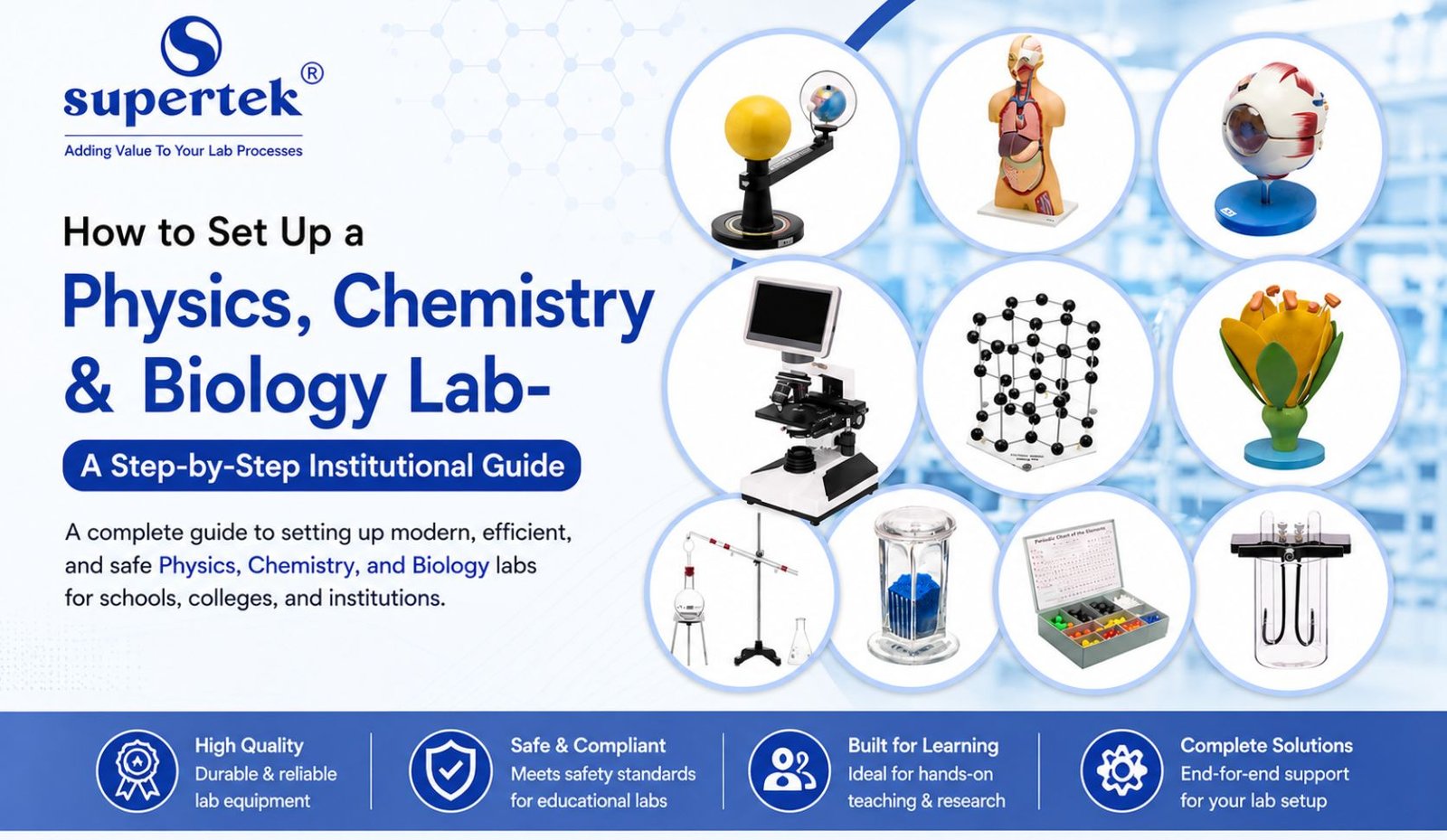
Establishing a science laboratory setup is among the significant investments an institution can make. A properly designed laboratory not only houses equipment but also moulds how students think, experiment and develop their scientific reasoning. If you are creating from nothing or renewing an existing place, adhering to an organised method assures the lab’s safety, usability and preparedness for future needs.
Start with a Space and Safety Audit for Science Lab Setup
Before you buy any equipment, make sure to assess the physical space. Take measurements of the floor area, check ventilation, inspect electrical outlets, and verify the availability of drainage. Different science subjects have unique needs – for chemistry, there should be fume hoods and surfaces that resist acid; biology requires refrigeration units and places to dispose of biohazards; physics asks for floors free from vibration due to delicate instruments. Document every constraint before planning further.
Also Read: How to Choose the Right Lab Equipment Supplier for Your Needs
Draft a Lab Layout Based on Discipline
Every lab has to be created keeping its main workflows in mind. In chemistry labs, the workbenches need to face ventilation sources, and fire safety tools should be within reach at every station. Biology labs benefit from a layout that separates wet zones from microscopy and specimen storage areas. Physics labs setup require an open floor area for mechanics experiments and specific dark zones for optics. A scaled sketch of the floor made prior to acquisition can save a great amount of time and money.
Procure Equipment in a Priority Order
Often, institutions make the mistake of purchasing everything at once. Instead, it is better to split buying into three levels. The first level includes safety items that cannot be compromised: fire extinguishers, eyewash stations, first-aid kits, safety cabinets, and emergency shutoffs. The second level encompasses the main experimental equipment that matches the curriculum. The third level involves additional tools and items that are used up over time. Using this phased method helps avoid exceeding the budget and ensures that safety is not sacrificed in favour of equipment diversity.
Also Read: Essential Questions to Ask Your Lab Equipment Dealer
Install Utilities and Storage Systems for Science Laboratory Setup
Certified professionals must install water, electricity, and gas lines in accordance with institutional and local safety rules. Every utility line should be clearly labelled, with individual shutoff valves at each workstation. Equally important is storage. Chemicals should be stored according to their compatibility class, not alphabetically. Biological samples require units in which the temperature can be controlled. Physics instruments require cabinets that are padded and vibration-resistant. Proper storage will extend the lifespan of all resources in the lab.
Develop a Lab Operations Manual for the Science Lab
A Science Laboratory Setup without written procedures can cause problems. Create a detailed operations guide that includes rules for entering and exiting, equipment-handling procedures, waste-disposal methods, incident-reporting steps, and maintenance timelines. This handbook should be created together with the teaching staff, checked by a safety officer and available for all employees and students to access it easily. Copies in digital form, placed near entrances, make certain everyone operates with guidance.
Train Staff Before Students Enter
It is not allowed for any student to enter a working lab before all overseeing staff have completed their official training. This involves learning to use equipment, responding to chemical and biological hazards, practising emergency evacuation procedures, and performing regular maintenance. Putting effort into making sure that the staff are competent is probably the most effective way an institution can minimise risk. Supervisors with good training keep lab environments very orderly, and this continues across different groups of students.
Commission the Lab with a Trial Run
Prior to starting the initial official session, ensure a complete commissioning test is conducted. Use every instrument, check all utility lines, and simulate a spill emergency. Confirm that each safety system reacts appropriately. Any discrepancies should be noted and resolved before students come in. A commissioned lab is not only furnished but also confirmed to be ready.

Supertek has earned a reputation as one of the most trusted manufacturers of Educational Teaching Aids, Laboratory Glassware, and Laboratory Essentials. As an ISO 9001:2015 certified organization, we are committed to maintaining the highest standards of quality and reliability. Supertek has grown into a leading exporter from India, serving customers in more than 80 countries across the globe.

 +1 (630) 345-3450