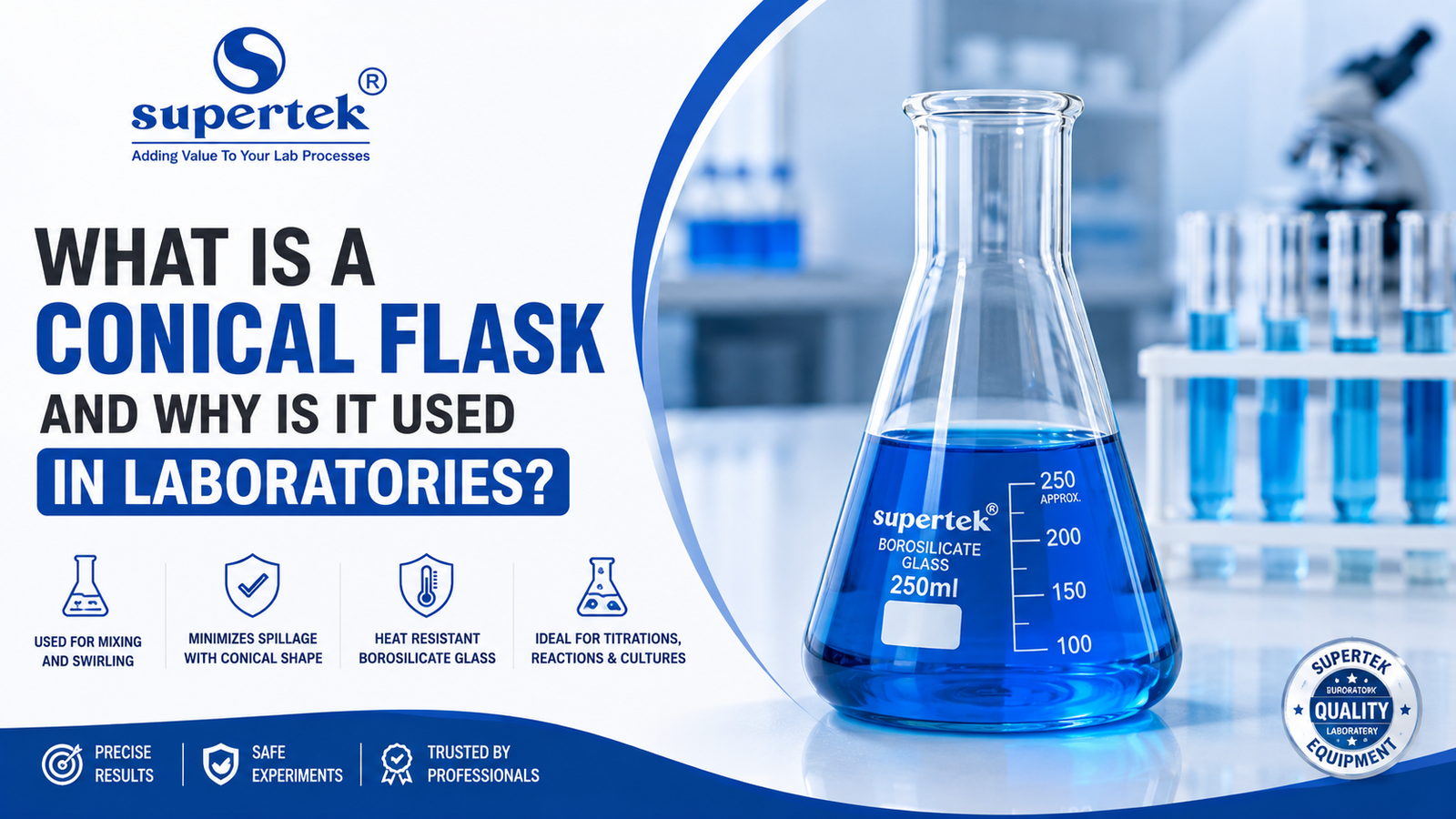
One of the most common glassware items in any scientific lab is the conical flask. It has a flat bottom and a wide conical body that tapers up and has a short cylindrical neck. This unique form isn’t just for aesthetics. Each curve and angle has a purpose, making this flask one of the most useful and versatile tools in a modern laboratory.
The Basic Design and Structure
The flask is usually constructed of little glass, which is heat resistant and able to withstand chemical reactions. Most versions also have volume units marked on the side; they can be used to reasonably estimate the amount of liquid, although different versions may have different marking systems. The narrow neck is another important feature, as it minimizes spills, and reduces evaporation during experiments. This makes it much more useful for many purposes than an open beaker.
Why the Shape Matters
Conical shape makes it easy to swirl liquids without the risk of spills. The broad base stabilises the liquid and the fine neck provides movement, for mixing the solutions during titration or other scientific activities. It is not simply a minor aspect. The accuracy of results are directly affected by the controlled mixing. In the end, it is a standard choice for many labs worldwide as a flask that spills or causes an uneven mix will ruin the whole experiment.
Common Uses in the Laboratory
Conical flasks are used for various purposes in scientific work. Usually such a device is employed in titration experiments where it is vital to have an accurate measurement and mixing. They can be used for titration and also for preparing solutions, putting away chemicals for the short term, heating liquids on a hot plate or flame, and doing chemical reactions that involve swirling the liquid. They are invaluable in research institutions, industrial testing facilities, or school laboratories, thanks to their ability to handle multiple tasks simultaneously.
Also Read : Professional Science Laboratory Setup Guide for Schools and Colleges
Role in Titration Experiments
The conical flask may be the most familiar of applications in titration. In this process a known volume of a solution is titrated with another solution until a chemical reaction comes to the end point. The solution that is being tested is in a flask and the titrant is added drop-wise from the burette. The analyst swirls the flask to make sure it is thoroughly mixed. This conical shape helps to make this process smoother, more controlled and much less prone to errors from splashing or uneven mixing.
Heating and Chemical Reactions
Conical flasks may also be directly placed on heating equipment as necessary. The flat base assures stability on hot plates and borosilicate glass withstands thermal stress. This makes them good to use when solutions need to be heated, or reactions are performed that yield gas. A stopper or rubber bung can also be added to the neck so that gasses may be collected or controlled safely during such processes.
Also Read : What Makes a Laboratory Equipment Manufacturer Reliable for Schools and Colleges? A Buyer’s Checklist
Choosing the Right Flask for Your Lab
All conical flasks may not be equal. These are available in a variety of sizes, generally 50 ml to 2000 ml; the correct size will be determined by the volume of liquid to be measured and the type of experiment being conducted. In the educational lab, smaller sizes are typically used, and larger industrial or research applications may need larger capacities. At Shivsons, emphasis is always on delivering glassware which at every stage is subjected to reliable quality standards as per various laboratory requirements.
Final Thoughts
The real practical problems of laboratory science are solved by the conical flask, hence it remains a staple of the world of science in laboratories. Its design and construction ensure it is reliable for various tasks, such as accurate titration and safe heating.
Related Blogs :
Laboratory Plasticware vs Glassware: When to Use Which in Your Lab
Lab Equipment Export from India- Process, Certifications & What Mistakes to Avoid
Cost Saving Strategies for Lab Equipment Distributors
Glass Lab Equipment: Complete Guide to Types, Materials, Standards, and Reliable Supply

Supertek has earned a reputation as one of the most trusted manufacturers of Educational Teaching Aids, Laboratory Glassware, and Laboratory Essentials. As an ISO 9001:2015 certified organization, we are committed to maintaining the highest standards of quality and reliability. Supertek has grown into a leading exporter from India, serving customers in more than 80 countries across the globe.

 +1 (630) 345-3450