
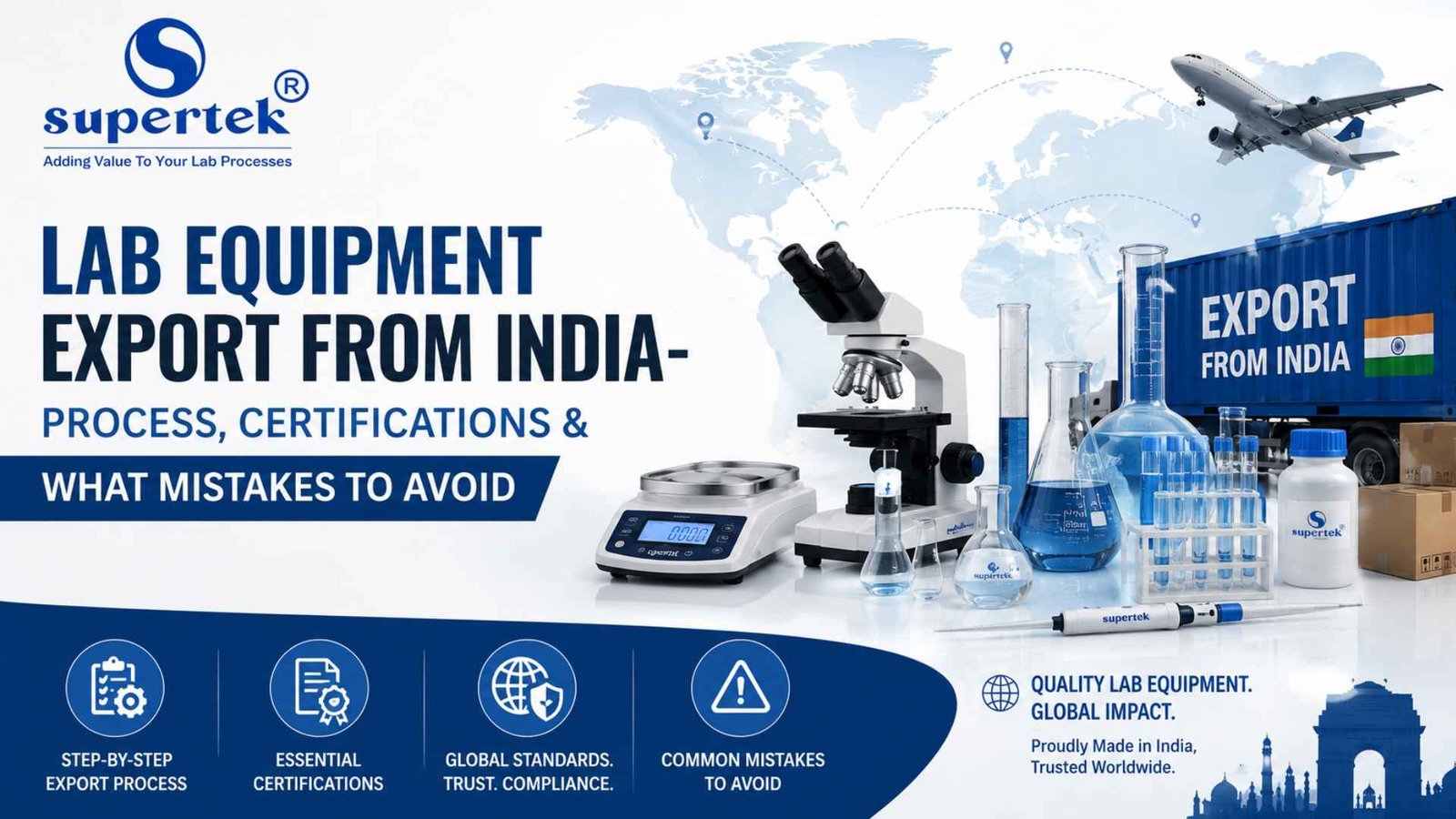
Today, India has emerged as one of the fastest-growing exporters of laboratory equipment. Manufacturers of India are providing excellent scientific equipment to customers worldwide. The list of their buyers ranges from academic institutions, research labs, to pharmaceutical firms, hospitals, and industry testing centres. There has been an increasing demand for laboratory equipment made in India.
However, exporting laboratory equipment goes far beyond the production and delivery of goods. Planning, following export requirements, creating documentation, obtaining international certificates, and securing packaging are essential processes. Even the smallest mistake may result in delayed shipments, problems at customs or unsatisfied clients.
We have vast experience in manufacturing and supplying laboratory equipment for more than 8 decades in both domestic and international markets.
This guide will help you understand all the processes involved in exporting, the necessary certifications, and the mistakes to avoid during exporting.
Why Is India So Distinguished As an Exporter of Laboratory Instruments?
India has distinguished itself as a dependable manufacturing base owing to its advanced manufacturing technology, skilled workforce, and pocket-friendly market. Laboratory instruments manufactured in India are extensively used in scientific research, pharmacology, healthcare, food analysis, environmental research, and industries.
The main reasons why foreign customers prefer Indian manufacturers are:
- Affordable manufacturing while maintaining quality
- Provision of a variety of laboratory instruments
- International quality standards compliance
- Good engineering skills and customisation ability
- Efficient export facilities
Global industries are investing heavily in research and development. The demand for reliable and trustworthy laboratory equipment manufacturers is continuously rising.
ALSO READ: Cost Saving Strategies for Lab Equipment Distributors
Step-by-Step Process Guide for Exporting Lab Equipment
1. Understanding Customer Requirements
The first step in any successful export is to identify the buyer’s precise needs. The equipment itself might have different dimensions and uses for different industries, test procedures, and countries.
Before production begins, manufacturers should confirm:
- Technical specifications
- Equipment dimensions
- Voltage and frequency requirements
- Material specifications
- Performance parameters
- Accessories and spare parts
- Warranty terms
Clear communication at this level prevents misunderstandings in the future.
2. Production and Quality Assurance
After the specification is agreed on, the equipment is produced through the quality-assured process. It is important that the item is tested thoroughly prior to shipment to ensure precision, reliability, and performance.
The usual checks consist of:
- Testing of functions
- Calibration testing
- Electric testing
- Temperature or performance testing (depending on the nature of the equipment)
- Final visual inspection
It is important to conduct thorough checks because the equipment must be accurate and reliable.
3. Export Documents
Proper documentation is an extremely important element of foreign trade. Failure to provide the necessary information can cause delays at customs and incur extra shipping expenses.
- Examples of documents needed for exports:
- Commercial Invoice
- Packing List
- Bill of Lading/Air Waybill
- Certificate of Origin
- Export Declaration
- Insurance Certificate
- Product Test Reports
- Warranty Documents
4. Packaging and Transporting
Equipment that comes from laboratories is usually very delicate and has to be packed in export packing materials to protect them during transit.
Some of the packaging materials used by manufactures include:
- Shock-absorbent foams
- Export wooden crates
- Moisture-proof packing
- Wrapping
- Fragile stickers
Correct packaging reduces the probability of equipment being damaged during transport.
5. Customs Clearance and Transportation
The laboratory equipment packaging will then undergo customs clearance prior to entry into the destination country.
ALSO READ: Glass Lab Equipment: Complete Guide to Types, Materials, Standards, and Reliable Supply
Key Certifications Required for Export of Laboratory Equipment
As per the destination country and the product line being exported, certain certifications may be necessary in order to show compliance and quality.
ISO 9001 Certification
The ISO 9001 certificate means that the company has adhered to certain standards as far as its quality management system is concerned. Most international buyers like suppliers who have ISO certification.
CE Marking
For export into most European countries, CE marking signifies that the products are in line with certain safety, health, and environmental criteria.
RoHS Compliance
Electrical and electronic laboratory equipment in certain cases may require RoHS compliance, which bans certain hazardous elements used in production.
Calibration Certificates
Most scientific instruments require calibration certificates to show that the instruments measure accurately and their traceability to a standard is there.
Product Testing Reports
Testing reports from third parties assist international buyers in verifying their performance standards.
Common Pitfalls in Lab Equipment Exporting
Ignoring Country-Specific Regulations
The import policies vary from one country to another. Failing to take into account this fact will cause problems at customs.
It is important to check out local policies prior to exporting.
Lack of Proper Documentation
Missing certificates, improper invoices, and wrong packing lists are some of the most common reasons for problems at the custom checkpoints.
Pre-inspection of all documents before shipping is important.
Improper Packaging
Lab equipment in the majority of cases is susceptible to vibrations, moisture, and shocks. Incorrect packing will result in damage.
Correct packing is required for the safe shipping of lab equipment.
Neglecting Product Testing
Exporting lab equipment without testing it can increase the chances of performance problems.
All instruments must be checked and calibrated prior to sending.
Mistaking Product Classification
Classification mistakes can complicate the process of customs clearance and affect the calculation of duties.
Accurate product classification is important.
Overlooking Electrical Standards
Voltage and frequency standards differ from country to country. The equipment should be prepared in accordance with the electrical standards of the destination country.
Lack of After-Sales Support
International buyers value suppliers who provide instructions and technical support.
Reasons for Selecting Supertek Scientific Instruments
As one of the foremost manufacturers and exporters, we ensure that we provide premium-quality laboratory equipment which matches international standards of performance, safety, and reliability.
We manufacture our laboratory products through precision engineering and stringent quality controls while keeping customer satisfaction in mind.
We provide an exhaustive variety of laboratory equipment which caters to education institutes, pharmaceutical companies, hospitals, research centers, and industrial laboratories.
All of our products pass the test of quality before dispatch and are backed by proper documentation, export packaging, and technical help.
Our team of professionals also knows all the details about exporting laboratory equipment from India and helps the customers in the process.
Conclusion
The exporting of laboratory equipment from India is really beneficial for the manufacturers and buyers all over the world. The exporting procedure can be successful through knowing about the demands of the customers, quality, preparation of documents, certification, and no mistakes while exporting.
An expert in exporting will make the whole exporting process much easier for both the manufacturer and the customer. Being a company with experience in manufacturing top-grade laboratory equipment, Supertek is always committed to supplying high-quality laboratory equipment.



 +1 (630) 345-3450