
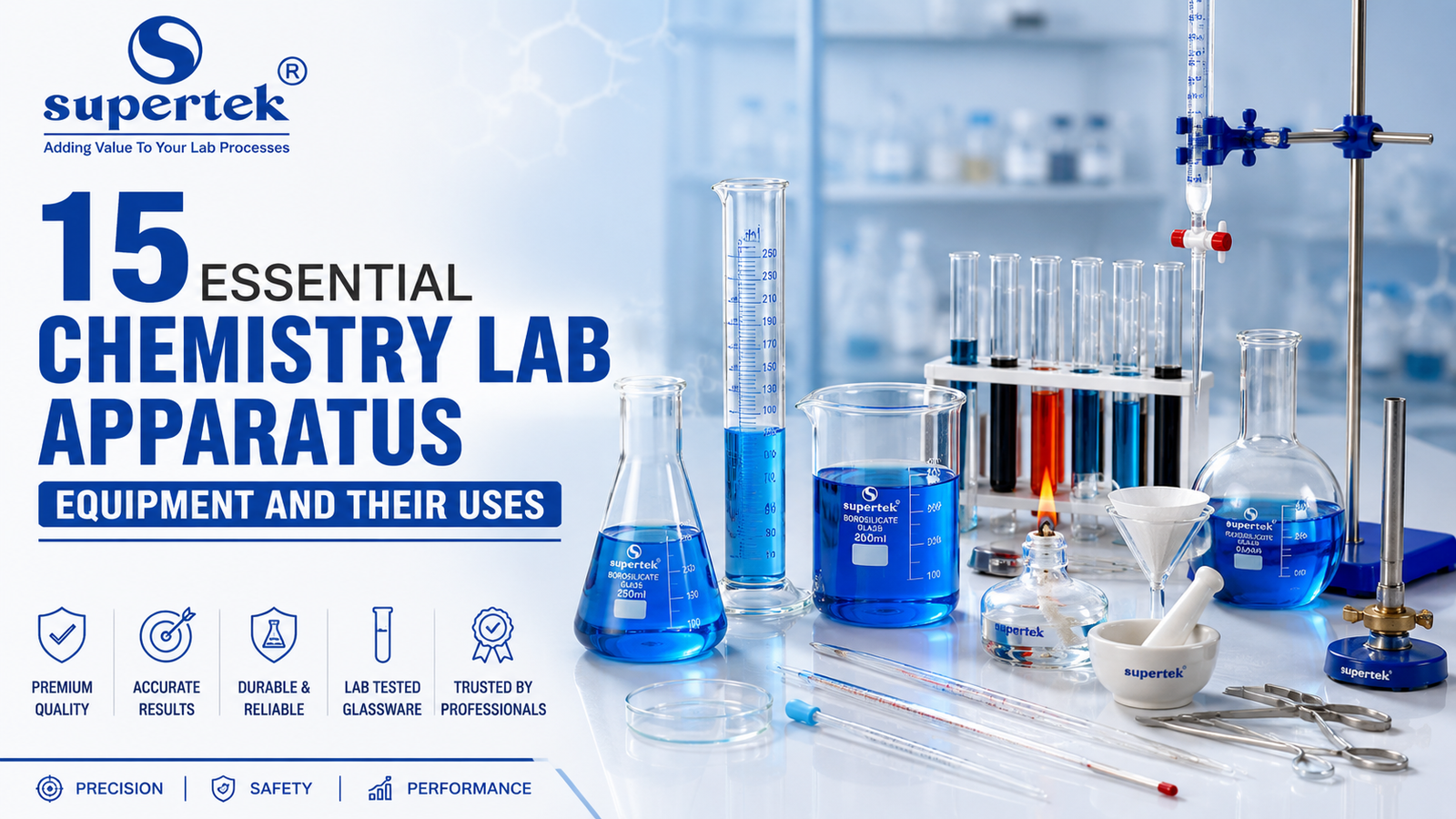
Precision is a key element of any chemistry lab, and the appropriate equipment is paramount. From beginner students entering the laboratory for the first time, to the professional doing advanced research, knowledge of apparatus is essential. Every piece of equipment has a particular function, and when used properly, they will be accurate and safe. 15 lab equipment items you need to know—along with their functions.
Beakers and Conical Flasks
Beakers are cylindrical containers used for holding, mixing and heating of liquids. Conical flasks (Erlenmeyer flasks) are used for swirling solutions without spilling. Both are of borosilicate glass, and thus have thermal shock resistance. Available in a range of volumes, they are suitable for nearly all categories of experiments at the school or professional laboratory.
Measuring Cylinders and Pipettes
A measuring cylinder is used to make approximate measurements of liquid volumes. Pipettes, however, provide a vastly increased degree of precision, and are indispensable for titrations and analytical work. Very small volumes are handled with micropipettes especially for biochemical and pharmaceutical research. The accuracy of your experiment results depends directly on the correctness of the measuring tool you use.
Bunsen Burners and Heating Mantles
Bunsen burners are used to produce an open flame for combustion reactions, sterilising apparatus and for the heating of substances. Heating mantles, which can heat uniformly without an open flame, are safer devices to use when handling flammable solvents. Both are essential for thermal experiments where they are to be controlled. Accidents and variations in results from repeated trials can be avoided by proper adjustment of heat levels.
Test Tubes and Boiling Tubes
Test tubes are thin, long glass tubes with narrow mouths that are used to hold small scale reactions and/or samples. Boiling tubes are longer and thicker and can be heated directly. Two are used along with clamps and stands whilst carrying out experiments. These are some of the most frequently used equipment in all chemistry laboratories, whether school or industrial quality control facilities.
Funnels, filter paper and spatulas
Funnels are used to pour liquids or powders into small openings without spilling. They can be used in filtration to remove solids from liquids in combination with filter paper. Spatulas are used to handle small amounts of solid chemicals in a contaminating-free manner. These three items are often used together in separation and purification procedures, and thus are a basic but important part of any lab tool kit
Buret, Clamp and Iron stand
Burettes are long graduated tubes with a stopcock in the bottom, which are mostly used for titration to measure accurate volumes of solution. They are attached to iron stands with the help of clamps; other apparatus such as flasks and condensers are also attached with the help of clamps. A secure setup is important for long reactions and good quality clamps and stands will avoid accidents through equipment tipping or shifting.
Evaporating Dishes and Watch Glasses
Evaporating dishes are wide shallow dishes used for evaporation of excess solvent and for the concentration of solutions. Watch Glasses are used for a variety of functions: to cover beakers so that they don’t become contaminated, as a weighing surface and to hold small amounts of substances to observe. Both are simple and essential tools which are used efficiently in dozens of common lab procedures.
Choosing the Right Lab Equipment
Good apparatus and accuracy is essential in every chemistry laboratory. Manufacturing a wide selection of lab equipment, Shivsons provides a well-crafted line of equipment designed for durability and precision, catering to the needs of students, researchers, and professionals. This investment in quality apparatus equates to less errors, safer experiments, and reliable results each and every time.



 +1 (630) 345-3450