
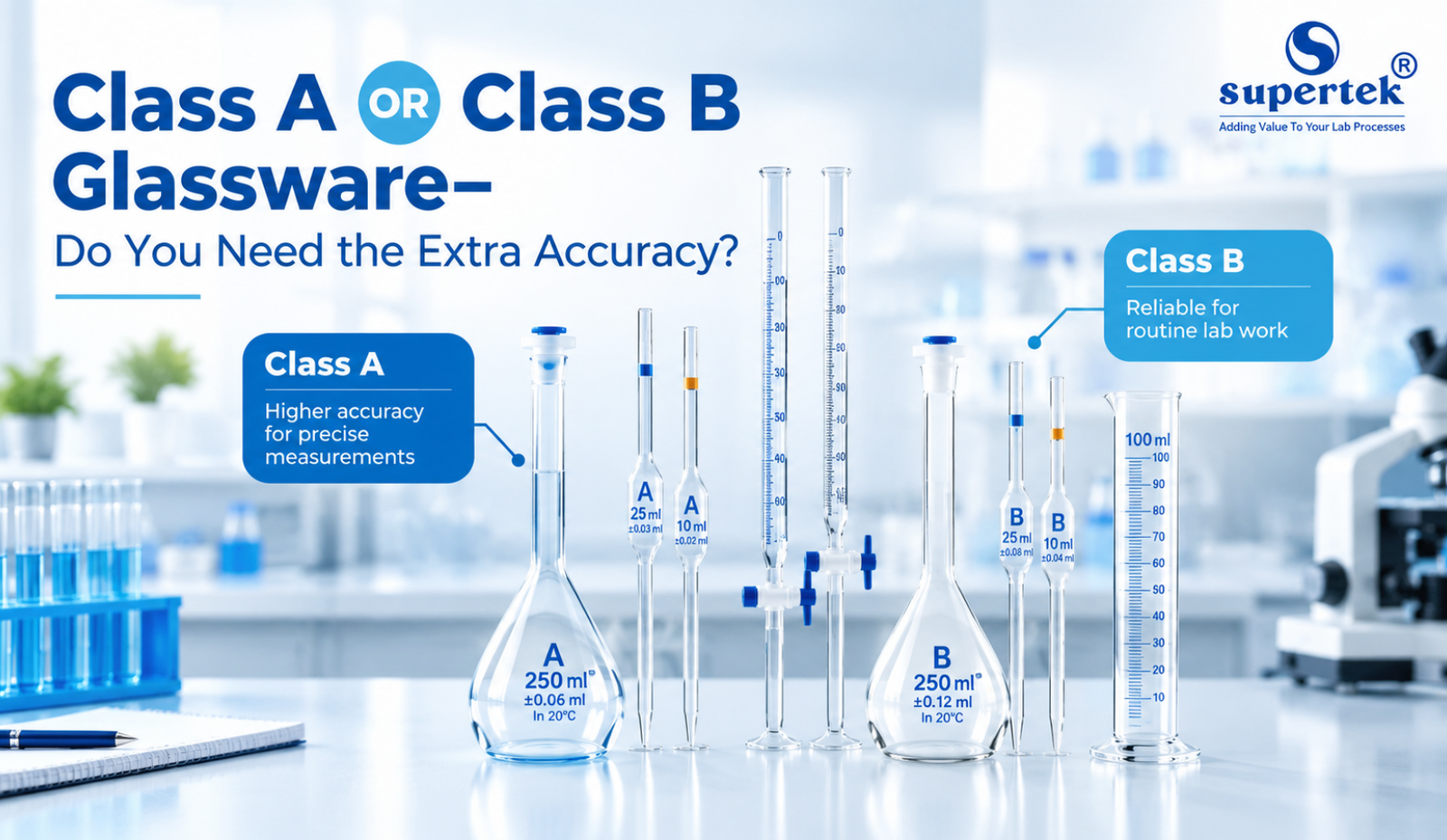
There are two volumetric flasks on a laboratory table, side by side. The capacity of both flasks is 100 ml; stoppers are present on both, and both have calibration marks. One flask is marked Class A, while the other flask is marked Class B.
Which one should be used?
The basic difference between Class A and Class B glassware is that Class A is less tolerant in terms of volume measurement, while Class B is more tolerant and may be used for educational purposes or regular work where tolerance requirements are satisfied.
Selection depends on a basic practical question: what is required in terms of accuracy?
What do Class A and Class B refer to?
Class A and Class B for volumetric laboratory glassware refer to their accuracy class. Such a classification sets the allowable deviation between the nominal and actual volumes under specific calibration conditions.
It is always presented as a tolerance in the form ±0.10 mL. The less the tolerance, the less volume tolerance is allowed.
Generally speaking, in the case of equivalent glassware described by the same standard, Class B has twice as much tolerance as compared to Class A. But one should always refer to the specifications of each piece of glassware.
Classification refers only to the volume measurement. This term does not describe the strength of glassware in any way.
How Important Is That Tolerance Difference?
Let us consider two Supertek 100 mL volumetric flasks:
- Class A volumetric flask with PP stopper: ±0.10 mL tolerance
- Class B clear-glass volumetric flask: ±0.20 mL tolerance
Both tolerances apply to ISO/DIN 1042 and borosilicate 3.3 glass. With these flasks, the difference is that the tolerance of the Class A flask will be only half that of the Class B one.
Compared to the nominal capacity, that difference will be 0.10% vs 0.20%, respectively. These values show the specified tolerance of that flask, not the total measurement uncertainty of the solution made with it.
Other sources of measurement uncertainty include weight measurements, temperature, the way of filling, etc. Thus, the flask’s greater tolerance reduces one source of error; it cannot compensate for all others.
You can see our other sizes and types of volumetric flasks.
When Do You Need Class A Volumetric Instruments?
Class A should be considered whenever accurate volume determination has an impact on the outcome.
These include such tasks as:
- Preparation of standard solutions.
- Creation of analytical dilutions.
- Transference of quantifiable amounts for testing purposes.
- Performing operations, which state a need for using Class A equipment.
Begin by reviewing your methodology. If it demands some specific tolerances, standards, or certificates. This will be your basis for selecting the necessary instruments.
For instance, our ASTM Class A volumetric pipettes claim a tolerance of ±0.02 mL for 10 mL pipette capacity. The range includes the ASTM E969 standard and offers a choice between batch certification and individual calibration certificates.
Thus, you get a clear measure for evaluating your procedural needs.
Pick the Right Instrument Before Picking the Class
Both of our Class A measuring cylinder and Class A volumetric flask are designed to serve specific functions. The two vessels do not share tolerances despite having the same classes.
The ISO Class A measuring cylinder with round glass bottom gives a tolerance of ±0.50 mL for 100 mL size and 1 mL divisions. The 100 mL Class A volumetric flask reviewed above gives a tolerance of ±0.10 mL.
It is an example of comparison of different instruments, and not comparison of Class A with Class B. This is why the purpose of each instrument becomes important.
Refer to the method to determine the required instrument:
- Volumetric flask: For preparation of a solution with a fixed volume.
- Volumetric pipette: To transfer a specified volume.
- Graduated cylinder: To measure different volumes.
- When you are in a dilemma about choosing a vessel, our guide on laboratory beakers and flasks will help you understand the role of each of them.
For transferring liquid, refer to the available volumetric and graduated pipettes with required specifications for your volume.
Is There Always an Individual Certificate With Class A?
Class A accuracy and the type of certificate are two distinct pieces of information.
An individual certificate is associated with a certain product, while a batch certificate is associated with a batch of products, depending on the supplier’s certification procedure.
The available Class A flasks, pipettes, and cylinders from us are available with batch certification and individual certificates. Make sure to look at your chosen catalogue number and certificate option.
Before making a purchase, make sure of the following:
- If your laboratory needs batch or individual certificates.
- How does it identify the glassware being supplied?
- If it has all the necessary information needed for your method.
- If any calibration procedure is needed.
Just because there is a Class A designation doesn’t mean everything else is in order.
What Else Should You Look at before Ordering?
Now that you have chosen the measuring instrument and the class, it’s time to examine the information concerning its applicability.
Capacity and tolerance
Make sure you look at the precise capacity you plan to buy. Different tolerances apply to different capacities, therefore the specification for 100 ml instrument cannot be applied to 500 ml one.
Applicable standard
Make sure that the product complies with ISO, ASTM or any other standard your method requires. Compare products that comply with the same standards where possible.
Calibration marking
The letters “TC” or “IN” mean that it is calibrated to contain. “TD” or “EX” – calibrated to deliver.
This difference affects the instrument’s use. Make sure you follow the markings and instructions accompanying the specific product.
Reference temperature
Check the reference temperature marked on the measuring instrument or specified in the documentation. The temperature is an important part of calibration conditions.
Material and closure
Examine the chemical resistance, glass type, stopper type, and operating conditions. An accurate class label does not mean applicability to all chemicals and applications.
You can find more information on common mistakes when buying laboratory glassware in our article.
Still Important Good Handling
Purchasing glassware with improved tolerances does not guarantee reliable measurement results.
Follow your lab’s guidelines when cleaning, conditioning, filling, reading, and draining the apparatus. Check your glassware before use and discard any defective pieces.
For general recommendations on glassware handling, refer to our laboratory glassware handling manual as well as to the user manual that comes with your glassware.
Choose Appropriate Glassware for Your Application
Consider the volume needed, the tolerance that can be accepted by your methodology, and the documentation required in your laboratory. Next, compare similar glassware based on the same specifications.
Check our laboratory glassware range for an idea of what is available. If you require assistance with choosing a specific item, contact the Supertek team with your application details.
To find more related information, browse the Glassware blog category. For more insights into material selection, go through our guide to laboratory plasticware vs. glassware.

Supertek has earned a reputation as one of the most trusted manufacturers of Educational Teaching Aids, Laboratory Glassware, and Laboratory Essentials. As an ISO 9001:2015 certified organization, we are committed to maintaining the highest standards of quality and reliability. Supertek has grown into a leading exporter from India, serving customers in more than 80 countries across the globe.

 +1 (630) 345-3450