
-
Mechanics
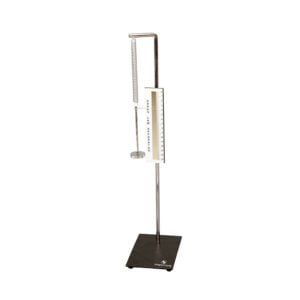
Young’s Modulus of Wires Apparatus Searle’s Pattern
Two metal frames are connected by a pivoted link which also carries a spirit level. A micrometer head reading to 0.01 mm is provided to re-adjust the spirit level. With two self-centering wire pin chucks, a ceiling bracket also with two pin chucks, a counterpoise weight & supply of suitable wires but without slotted masses.
PH10613S -
Mechanics
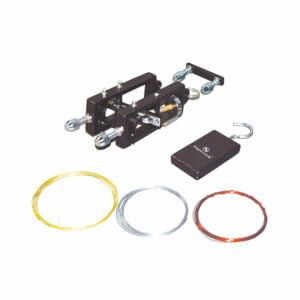
Strip Testing Clamps
A pair of strong aluminium clamps, which allows strip material to be investigated for breaking strain, stretch etc. The clamps have wing-nut fixings and an attachment system that ensures freedom from slip. These clamps are used to study the comparison of the strengths of bag materials, stretching of fabrics, stretching of plastics and newspaper strength. This is done by attaching one of the clamps to the clamp provided in the laboratory and loading the lower clamp with slotted weights. A maximum of 15kg of weight can be hanged. Supplied without weights.
PH10613S/2 -
Mechanics
Torsion of Metal Rods Apparatus Searle’s
Horizontal pattern, two heavy metal brackets are held together with connected rods. A heavy metal pulley, moving in ball bearings, is mounted on one bracket & is fitted with a three-jaw chuck to hold one end of the test rod, the other end being held in another chuck fixed to the other bracket. Two graduated scales are mounted on the connecting rod & two pointers can be clamped in any desired position on the test rod. With one brass & one steel test rod but without masses.
PH10613T -
Mechanics
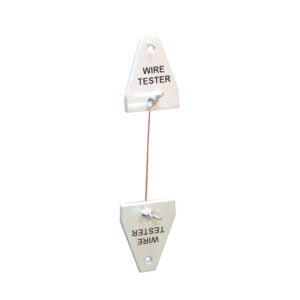
Wire Testing Clamps
This device provides an effective and very simple clamping system for testing the strength of the ductile wires such as copper, sewing threads, fishing lines and human hair etc. The material is clamped between the washers with the help of a wing nut clamp and the wire is routed through the holes provided in the clamps. The strength is checked by attaching one of the clamps to the clamp provided in the laboratory and loading the lower clamp with slotted weights. A maximum of 15 kg of weight can be hanged. Supplied without weights.
PH10613W -
Mechanics
Boyle’s Law Apparatus
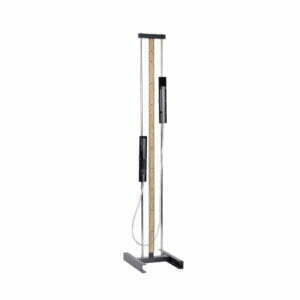
Two glass tubes 220 mm long, one with closed top and the other open end, connected by 1-meter pressure rubber tubing are mounted on two brackets sliding on two vertical metal rods fixed rigidly on a stand. With heavy cast iron base. The stand has a graduated scale of 0 to 100 cm. Supplied without mercury.
PH10614 -
Mechanics
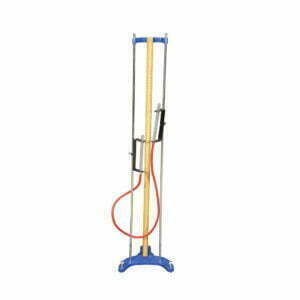
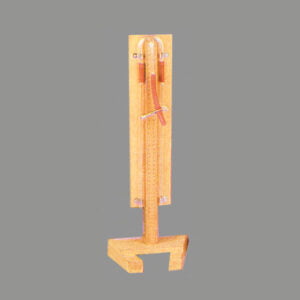
Boyle’s Law Apparatus
This precise apparatus is designed for demonstrating the Boyle’s Law (elasticity of gases). The apparatus illustrates accurate readings over a wide range of pressure. Two glass tubes, one with closed top and other open one connected together by a piece of flexible tubing, running parallel to one another on metal rods. This allows one of the tubes to be raised higher or lower than the other and then locked in place. This unit stands vertical on a metal H shaped base. Supplied without mercury.
PH10615 -
-
-
-
Mechanics
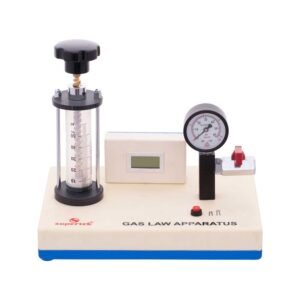
Gas Law Apparatus
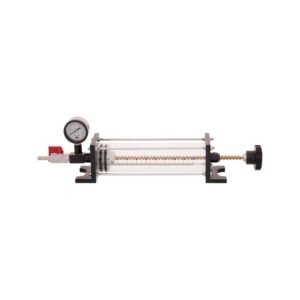
Gas Law Apparatus is ideal for studying the relationship between the pressure, temperature and volume of a gas. By turning the piston, volume of the air can be easily changed and the pressure as well as the temperature can be noted from the gauges. The gas law (PV=nRT) can be confirmed by repeating the process. Includes instruction manual.
PH10616T -
Mechanics
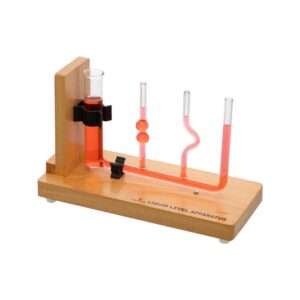
Hare’s Apparatus
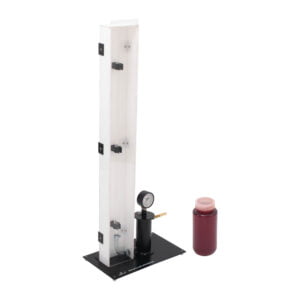
A three-limbed glass tube is mounted on a wooden stand with a scale for each of the two 600 mm tubes. A rubber tube with Hoffman clip is provided for the short limb. Two metal sliding distance rods may be so adjusted that their lower ends just touch the surface of the liquid under experiment to facilitate column height readings. Overall dimensions 680 x 300 x 150 mm approx.
PH10617




 +1 (630) 345-3450